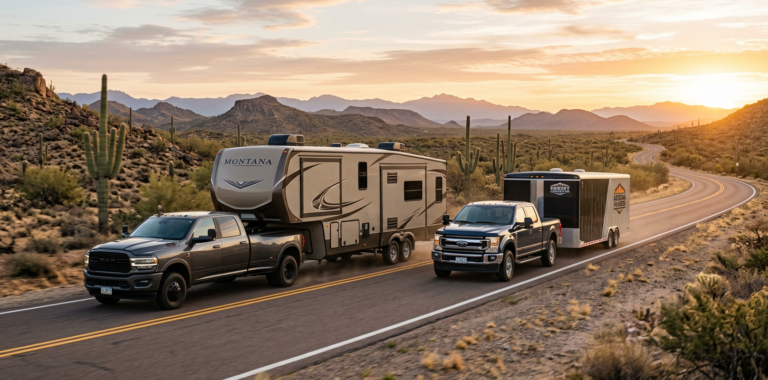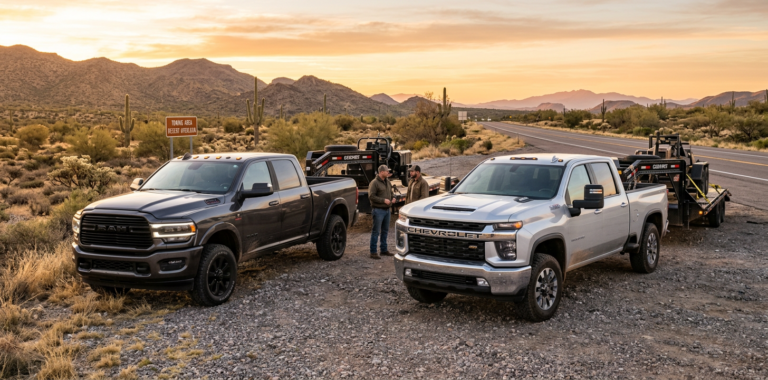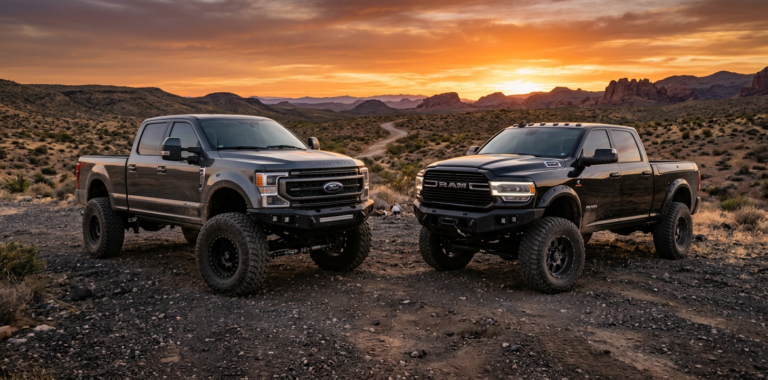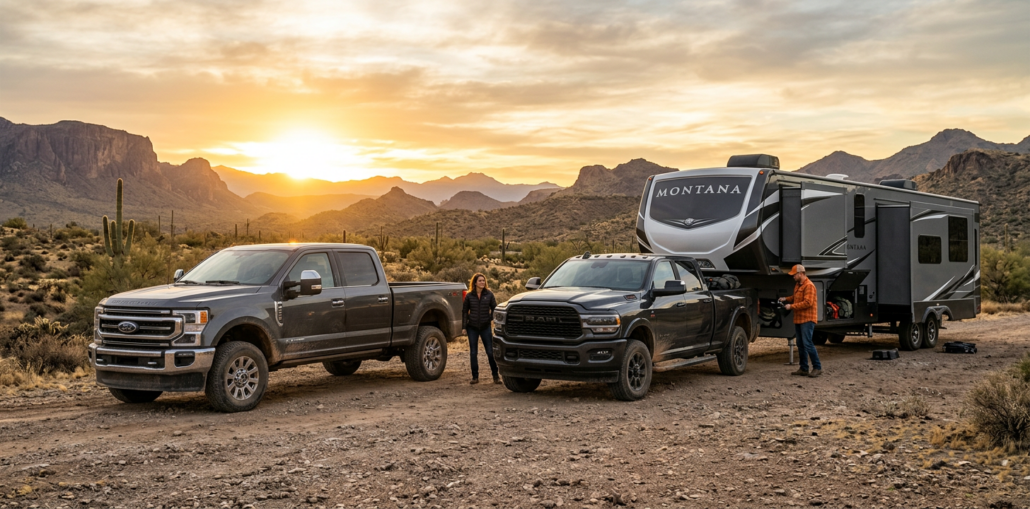
A heavy-duty pickup should be chosen around the load it will carry and pull, not simply the biggest number on a brochure. In a Ford Super Duty vs Ram Heavy Duty comparison, Ford usually gives buyers more maximum-capability configurations, while Ram stands out for Cummins diesel appeal, available rear air suspension, and an interior many owners appreciate on long towing days.
For most pre-owned buyers, the better truck depends on whether we need maximum gooseneck capability, a high-payload work setup, a comfortable fifth-wheel tow vehicle, or a truck that also has to handle everyday Arizona driving. The exact cab, bed, axle ratio, drivetrain, engine, trim, hitch equipment, and door-jamb payload label matter more than the badge alone.
Quick Ford Super Duty vs Ram Heavy Duty Comparison
Ford generally has the edge for maximum towing and lineup variety. Ram is a strong fit for buyers who want a Cummins-powered truck, available towing technology, and a refined road feel.
| Buying priority | Ford Super Duty | Ram Heavy Duty | Best fit |
|---|---|---|---|
| Maximum towing | Up to 40,000 lb | Up to 36,610 lb | Ford for extreme loads |
| Diesel engine | 6.7L Power Stroke V8 | 6.7L Cummins I6 | Personal preference and condition |
| Gas engine | 6.8L or 7.3L V8 | 6.4L HEMI V8 | Compare payload labels |
| Transmission | Ten-speed automatic | Eight-speed automatic | Drive both if possible |
| Fifth-wheel setup | Broad F-350 and F-450 options | Strong 3500 and dually choices | Match pin weight first |
Ford lists up to 40,000 pounds of properly equipped gooseneck towing for the 2026 Super Duty. Ram lists up to 36,610 pounds for a properly equipped 2026 Ram 3500 with the high-output Cummins diesel. Those are maximum ratings for specific trucks, not a promise that every F-250, F-350, Ram 2500, or Ram 3500 can handle the same trailer. Review the Ford Super Duty towing guide and Ram Heavy Duty capability information before narrowing your search.
Which Truck Is Better for Heavy Towing?
Ford is the stronger choice when we need the widest path to serious gooseneck and commercial-style towing. Ram deserves close consideration when our trailer fits its ratings and we prefer the Cummins inline-six diesel, available rear air suspension, or its particular cab and trim combination.
Ford Super Duty for high-capability towing
The Ford lineup ranges from F-250 models through F-350 and F-450 dual-rear-wheel trucks. That breadth matters because it allows buyers to choose a truck around a real job, from hauling equipment on weekdays to moving a large horse trailer or fifth-wheel RV across the state.
For the 2026 model year, Ford offers 6.8L and 7.3L gasoline V8 engines plus standard-output and high-output 6.7L Power Stroke diesel V8 options. The high-output Power Stroke is rated at up to 500 horsepower and 1,200 lb-ft of torque, paired with Ford's ten-speed automatic transmission. Older trucks can differ substantially, so we recommend confirming engine output and tow equipment by VIN and model year before purchase.
An F-350 or F-450 dually can be especially attractive when loaded fifth-wheel pin weight, gooseneck cargo, or heavy work equipment is part of the routine. Buyers focused on that use should browse dual-rear-wheel trucks built for serious towing rather than assuming a single-rear-wheel truck has enough payload margin.
Ram Heavy Duty for Cummins power and fifth-wheel confidence
Ram Heavy Duty trucks come in 2500 and 3500 series, with a 6.4L HEMI gas V8 or available 6.7L Cummins turbo-diesel inline-six. For 2026, the high-output Cummins is rated at up to 430 horsepower and 1,075 lb-ft of torque, working with an eight-speed automatic transmission.
The Ram 3500's available auto-level rear air suspension can be appealing for drivers who tow regularly and value a level stance under load. Ram also offers trailer reverse steering technology on certain configurations, which can help when backing a large trailer. These features are useful, but they do not replace the need to verify payload, axle ratings, tire ratings, and hitch limits on the exact truck.
Payload Is the Number That Can Change the Answer
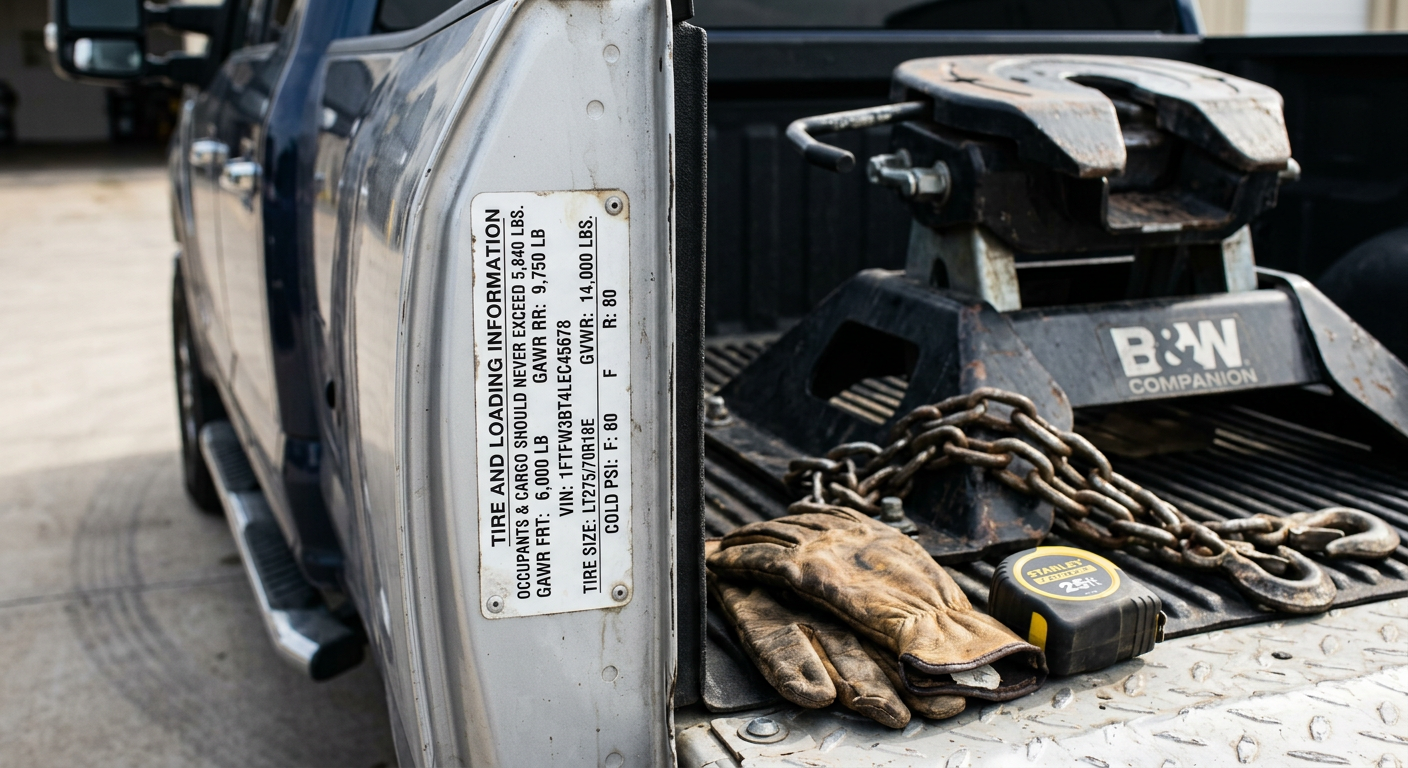
Payload often decides this comparison before maximum tow rating does. A trailer's hitch weight or fifth-wheel pin weight counts against the truck's payload along with passengers, a hitch, tools, bed cargo, and aftermarket accessories.
A heavy fifth-wheel can place a meaningful amount of weight directly in the bed. That is why a buyer may find that a truck with a huge towing claim still lacks enough remaining payload for a fully loaded family, hitch, generator, toolboxes, and trailer pin weight.
Start with the job we actually do
We recommend listing the loaded weight of the trailer, not its advertised dry weight. Then add the people, gear, hitch, fuel, coolers, recovery equipment, and anything else that travels in the truck.
For example, a buyer who tows a moderate travel trailer a few weekends a year may be well served by an F-250, Ram 2500, or single-rear-wheel one-ton truck. A buyer with a large fifth-wheel toy hauler or loaded equipment trailer may need the higher payload and rear-tire capacity of an F-350 or Ram 3500 dually.
This is also where gas trucks deserve a fair look. Ford rates some 2026 Super Duty gas configurations as high as 8,000 pounds of maximum payload, while Ram lists up to 7,590 pounds of maximum gas payload for the 2026 Ram 3500. Diesel trucks can be excellent towing tools, but the heavier diesel engine and added equipment may reduce payload compared with a similar gas configuration.
Gas vs Diesel: Which Ownership Plan Makes More Sense?
Gas is often the practical answer when bed load and occasional towing are the priority. Diesel can make more sense when we regularly pull heavy trailers, travel long distances, or want strong low-rpm torque and exhaust braking.
When a gas heavy-duty truck fits best
A gas F-250, F-350, Ram 2500, or Ram 3500 is worth considering if we tow locally, haul materials, run a work bed, or need stronger payload without diesel ownership costs. Gas trucks may also be a more straightforward fit for buyers who do not put enough loaded highway miles on a diesel to benefit from its towing strengths.
When a diesel truck earns its higher cost
A Power Stroke or Cummins diesel is often the better match for frequent heavy trailer use, long interstate trips, steep grades, and jobs where torque and engine braking improve confidence. Diesel ownership also brings emissions-system components, fuel-filter service, and potentially higher repair costs, so a documented maintenance history matters.
For buyers comparing late-model diesel pickups, our Scottsdale diesel truck selection is a useful place to compare Ford Power Stroke and Ram Cummins configurations side by side.
Ride, Daily Driving, and Work-Ready Details
Ram is commonly favored by buyers who want a heavy-duty truck that feels composed on longer drives. Ford appeals to many shoppers who need broader cab, bed, chassis, and towing-package choices, including F-450 capability for demanding work.
Neither truck is automatically easier to live with. A crew-cab long-bed dually from either brand will take up more room in parking lots than a short-bed single-rear-wheel truck. A lifted build can add another layer to the decision because suspension height, tire size, gearing, hitch height, and alignment all affect the way a truck tows and handles.
What we inspect on a pre-owned heavy-duty pickup
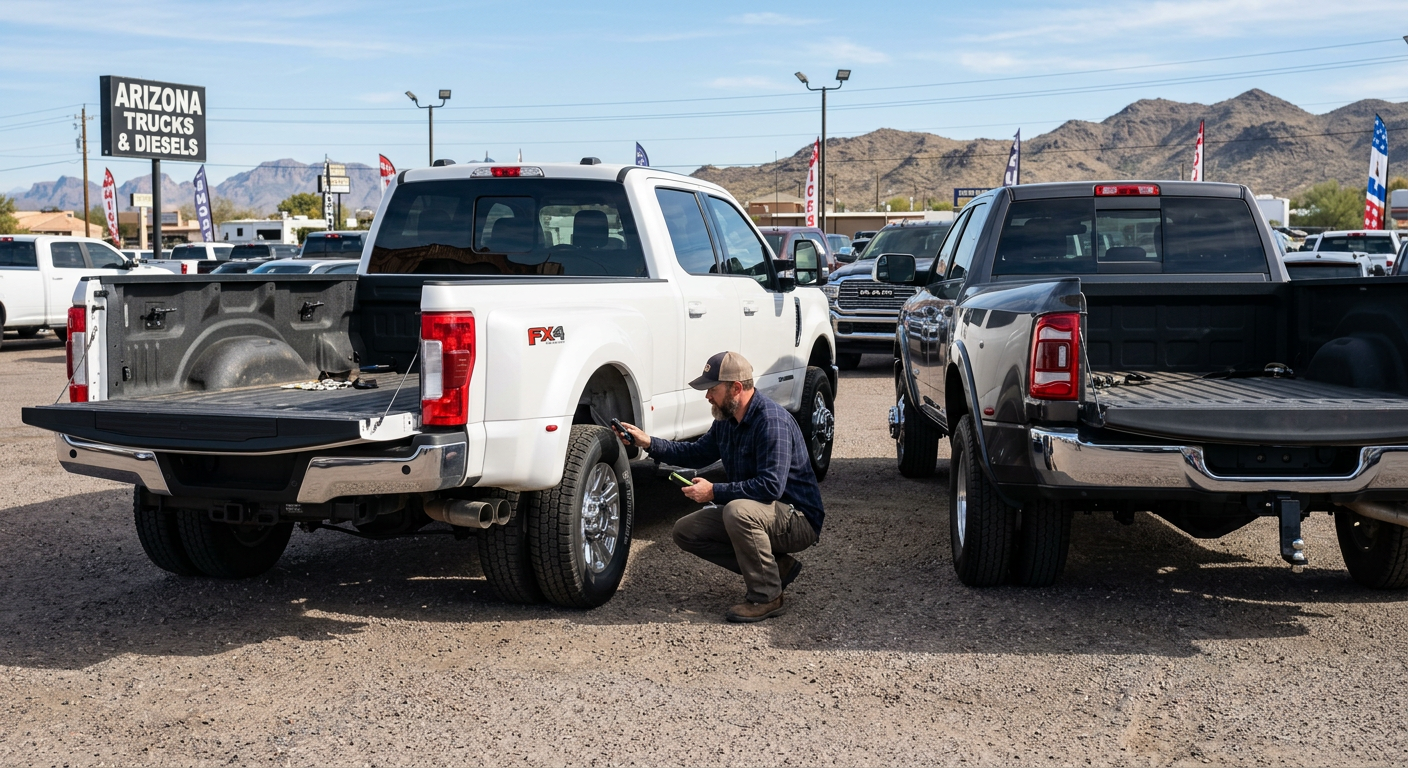
A strong pre-owned Ford or Ram starts with configuration, condition, and records. Before committing, we suggest checking:
- The payload sticker on the driver-side door jamb
- Bed length, rear-wheel setup, axle ratio, and factory hitch preparation
- Tire age, load rating, tread condition, and matching tire sizes
- Evidence of regular diesel fuel-filter, oil, and transmission service
- Condition of the hitch, wiring connector, brake controller, and trailer camera equipment
- Quality and documentation for lifts, wheels, tires, tuning, or suspension modifications
- Signs of heavy commercial use, corrosion, or incomplete repair work
For a truck that will spend its life on jobsites, it also helps to compare heavy-duty work trucks for Arizona businesses with the actual tools, payload, and trailer requirements we expect to carry.
How We Would Choose Between Ford and Ram
The right answer becomes clearer once we stop comparing headline numbers and choose around real loads. Ford is usually our first recommendation for buyers who need the broadest range of high-capability configurations. Ram is often a compelling match for buyers who specifically want Cummins diesel power, available rear air suspension, and a capable long-distance towing truck.
Choose Ford Super Duty if
- We need maximum gooseneck or fifth-wheel potential
- We want to compare F-250, F-350, and F-450 configurations
- We need a gas truck with strong possible payload ratings
- We want a truck for equipment, livestock, or commercial-style hauling
- We need a specific cab, bed, dually, or upfit-ready arrangement
Choose Ram Heavy Duty if
- We prefer the Cummins inline-six diesel platform
- We value available rear air suspension for regular towing
- We are shopping for a Ram 2500 or 3500 that balances towing with daily comfort
- We need a strong fifth-wheel or travel-trailer setup with the right payload label
- We find a well-maintained pre-owned Ram with the correct configuration and service history
Questions Buyers Ask Before Buying
Is an F-250 better than a Ram 2500 for towing?
Neither is automatically better because the exact truck configuration changes the answer. Compare the payload sticker, hitch type, axle ratio, cab, bed, engine, and loaded trailer weight before deciding.
Is an F-350 better than a Ram 3500 for a large fifth-wheel?
Both can be excellent choices, but a dually version of either truck may be the safer fit when pin weight is high. The best decision comes from matching the loaded fifth-wheel weight to the truck's payload, rear axle, tire, and hitch ratings.
Does a Cummins diesel last longer than a Power Stroke diesel?
Long-term ownership depends more on maintenance, use, service history, and the condition of the complete truck than engine reputation alone. We recommend reviewing records, inspecting the truck carefully, and considering a pre-purchase inspection for any high-value diesel purchase.
Can a lifted heavy-duty truck still tow safely?
It can, provided the suspension, tires, steering, driveline angles, brakes, and hitch height are appropriate for the load. We should confirm that the trailer sits level and that the modification does not reduce safe operating capacity or create clearance issues.
Should we choose a long bed for fifth-wheel towing?
A long bed often gives more clearance between the trailer and cab, especially during tight turns. Short-bed trucks can work with the correct hitch setup, but buyers should verify the trailer and hitch combination before purchase.
Can we finance a pre-owned Ford Super Duty or Ram Heavy Duty?
Yes, financing availability depends on factors such as vehicle age, mileage, down payment, loan term, and credit profile. We can start the process through the truck financing options at Unique Trucks or submit a secure online pre-qualification request before selecting a truck.
Compare the Right Heavy-Duty Truck for Your Load
A capable truck feels much better when it is matched to the trailer, cargo, and driving routine we actually have. Browse the current heavy-duty truck inventory, or use the Vehicle Finder service if we need a particular engine, bed length, dually setup, or towing package.
Our team can help buyers in Scottsdale, Phoenix, across Arizona, and nationwide compare pre-owned Ford Super Duty and Ram Heavy Duty options without pressure. Call (480) 210-2660 or schedule a test drive when you are ready to look at the trucks that fit your job.
The Better Truck Is the One That Leaves Us Margin
Ford Super Duty and Ram Heavy Duty trucks are both serious tools, but the best one is the truck that leaves room for passengers, cargo, hitch weight, and changing demands. Ford has the advantage for buyers chasing the highest towing ceiling and configuration variety, while Ram has a strong case for Cummins-focused shoppers and frequent fifth-wheel towing.
Before buying, weigh the loaded trailer, inspect the payload label, and verify every rating on the exact truck. That process gives us more confidence than choosing based on a tailgate badge or a maximum rating alone.
About Unique Trucks
Unique Trucks is a family-owned dealership with over 20 years of experience serving truck buyers in Scottsdale, Phoenix, throughout Arizona, and nationwide. Located at 8701 E McDowell Rd in Scottsdale, AZ, Unique Trucks specializes in quality pre-owned lifted trucks, diesel trucks, custom trucks, heavy-duty pickups, work trucks, and used SUVs.
The Unique Trucks team helps buyers explore financing, trade-ins, vehicle sourcing, and nationwide shipping with a straightforward, no-pressure buying experience.
Browse the current truck inventory, get pre-qualified online, or call (480) 210-2660 to speak with the Unique Trucks team.
YOUR NEXT STEP
Put your research to work.
Explore your options or ask our Scottsdale team about a truck that fits your needs.